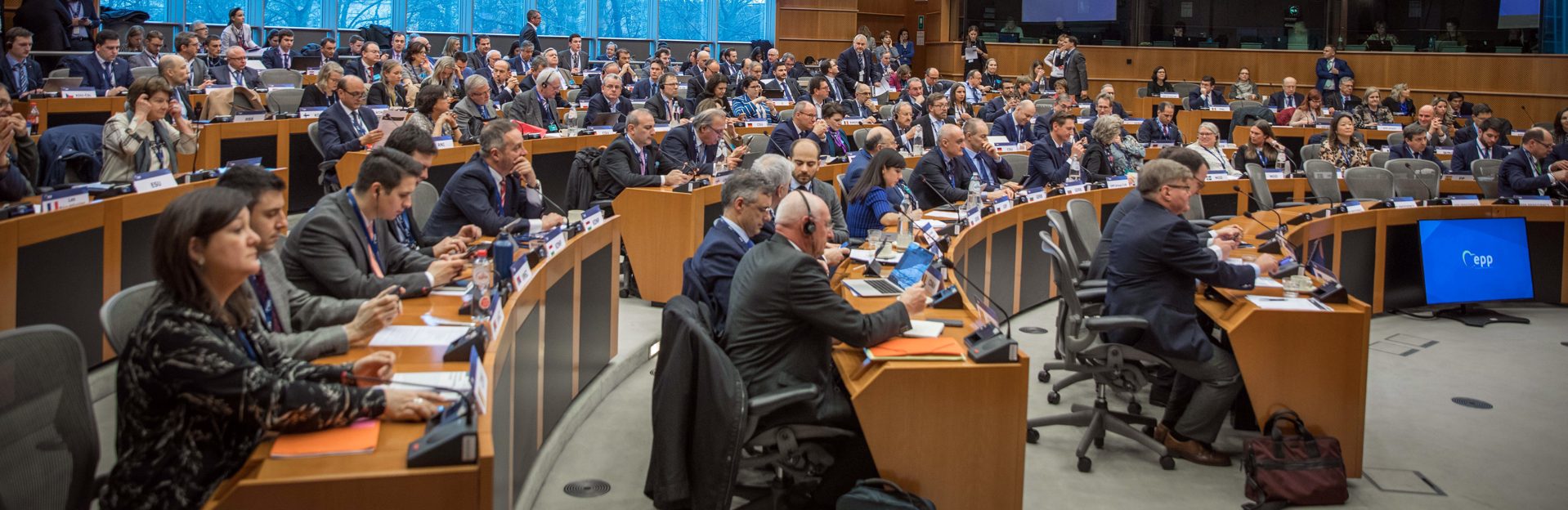
The leaders of the European People’s Party (EPP), invited by EPP President Manfred Weber and Prime Minister and President of the Croatian Democratic Union – HDZ, Andrej Plenković, will meet in Zagreb on 30-31 January 2026.
“In times of geopolitical volatility, the EU must be ready to act. As the driving force in Europe, the EPP must be ambitious going forward and make sure the EU architecture is fit to overcome future crises”, stated EPP President Manfred Weber.
In this context, EPP leaders will gather to discuss Europe’s role in the world and outline the party’s priorities for 2026.
Information to pressDates: starting on Friday 30 January 2026 from 15:30 and ending on Saturday 31 January 2026 at 12:30.
Press registration will open on Friday at 14:00.
Venue: Westin Hotel, Kršnjavoga 1, 10000 Zagreb
Journalists wishing to cover the EPP Leaders’ Retreat must register by 29 January via the following link: https://forms.office.com/e/3a6huCE0eQ
For security reasons, please ensure that you bring a valid form of identification and press ID (either badges issued by the European Council or national press ID cards).
The EPP Manifesto outlines the basic principles of the Party summary.
The EPP Manifesto outlines the basic principles of the Party summarising who we are, what our
values are, what challenges are we facing and what vision we have for the future. The
Manifesto was developed in parallel to the EPP Platform document within the EPP Working
Group 1 for “European Policy”.
The EPP Platform is the core programme of our party outlining our main values,
explaining the challenges our society is facing and presenting our vision for the
future of European Union.
The Party Platform was developed in EPP Working Group 1 for “European Policy” chaired
by EPP President Wilfried MARTENS ?and EPP Vice President Peter HINTZE. The Working
Group consists of delegates of EPP member parties who prepared and worked?on this
document for more than two years and received input?from the drafting committee as
well as senior and young experts. The document was adopted at the 2012 EPP Congress
in Bucharest, thus replacing the Basic Programme of Athens from 1992.
We use cookies to ensure that we give you the best experience on our website. You may accept or
manage your choices by clicking below.
Privacy Policy
Disclaimer
The European People’s Party (EPP) maintains this website to enhance public access to information
about its initiatives. Our goal is to keep this information timely and accurate. If errors are
brought to our attention, we will try to correct them. This privacy policy will explain how our
organisation uses the personal data we collect from you when you use our website.
If you would like to read more about our use of cookies please view our Privacy policy.
Your Privacy
When you visit any web site, it may store or retrieve information on your browser, mostly in the form
of cookies. This information might be about you, your preferences or your device and is mostly used
to make the site work as you expect it to. The information does not usually directly identify you,
but it can give you a more personalised web experience.
Because we respect your right to privacy, you can choose not to allow some types of cookies. Click on
the different category headings to find out more and change our default settings. However, blocking
some types of cookies may impact your experience of the site and the services we are able to offer.
Strictly Necessary Cookies
These cookies are necessary for the website to function and cannot be switched off in our systems.
They are usually only set in response to actions made by you which amount to a request for services,
such as setting your privacy preferences, logging in or filling in forms.
You can set your browser to block or alert you about these cookies, but some parts of the site will
not then work. These cookies do not store any personally identifiable information.
Performance
Cookies
These cookies allow us to count visits and traffic sources so we can measure and improve the
performance of our site. They help us to know which pages are the most and least popular and see how
visitors move around the site.
All information these cookies collect is aggregated and therefore anonymous. If you do not allow
these cookies we will not know when you have visited our site, and will not be able to monitor its
performance.